
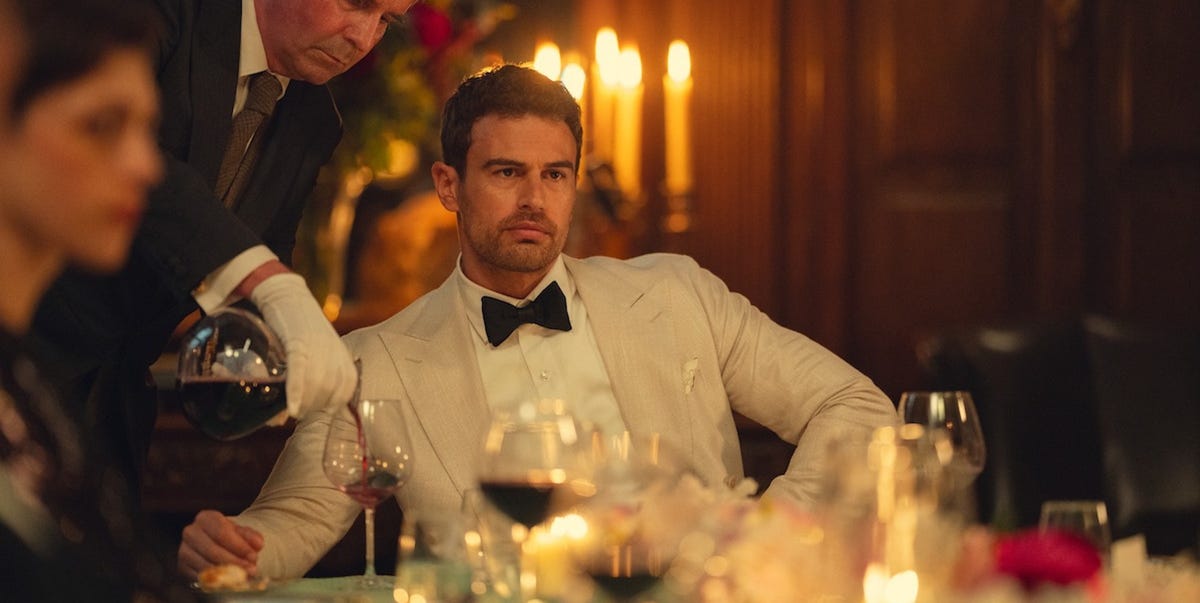
Get out the hyper-decanter: we’re off for dinner at the Duke’s.
Theo James has returned to the role of the dashing Eddie Horniman, a former army captain seduced by a life of crime, for Netflix’s The Gentlemen. The new series is all about bella Italia, as the Halstead-Glass weed-producing empire spreads to the Mediterranean, with farms beneath sprawling Italian castles and villas. But to keep everyone onside, and impress a random lord and a sheikh, Eddie hosts a classic English hunting weekend that culminates in a banquet with a frankly ridiculous selection of wines.

Christopher Raphael
Obnoxious guest Cico Maldini (Michele Morrone) claims one of the megabucks vintages is “corked”. It’s not, he’s just being a dick. But there’s no getting away from the fact that Eddie’s wine list is all about pulling out the big guns. “This isn’t a wine list designed simply to impress,” says Katie Lawton, a London-based wine communicator, found at @endofthewine. “It’s designed to establish dominance.” On that note, let’s get stuck into all the wines featured in this oenophile’s dream of an episode.
 Pétrus, Pomerol, 2009 and 1998
Lucky Lord Hawthorne (Hugh Bonneville) practically gets doused in Pétrus as Eddie butters him up in the hope of being made a lord. They sip a 1998 bottle before dinner, which Lawton says “is one of the most highly regarded Pétrus vintages of the decade and received 100 points from Jancis Robinson”. The current market price for a bottle of the 1998 is around £4,000.
And there’s no waltzing into Majestic to buy one of these bottles, she adds: “These are the kind of wines you can’t just pick up, you have to know the right people to get them. Opening a mature bottle of Pétrus is a statement – these are wines that are collected, traded and carefully cellared rather than casually opened at dinner.”
As for the double magnum of the 2009 that Eddie gifts Lord Hawthorne as an extra little sweetener to enter the “corridors of power”, it is “one of the most coveted wines in the world”, says Lawton. A double magnum of the stuff would run into the tens of thousands of pounds, with one listing at £47,000, and is an “outrageous flex”, she adds. “Serving a double magnum of Pétrus is less ‘would you like some wine?’ and more ‘welcome to my empire’.”

BBR.
Masseto
Masseto is a fitting wine to serve the Italian wine-whiner, Cico. “It’s essentially Italian fine wine royalty,” explains Lawton. “It’s a cult Tuscan 100% Merlot (same as the Pétrus) from Bolgheri and one of the wines that helped prove Italy could produce reds capable of competing with the world’s most prestigious bottles.” The cost? Currently around £700 to £1,000.
Château Mouton Rothschild 1989
Chateau Mouton Rothschild
The wine Cico reckons is corked also exposes the rivalry between Italian and French wine lovers, as he spits it out almost as soon as he learns it’s French. Definitely do not do this if anyone ever serves you a glass of Mouton, Lawton says. “Mouton Rothschild is one of Bordeaux’s legendary First Growth estates, and the 1989 is a seriously impressive, mature bottle. What makes Mouton particularly desirable is its collectability – every vintage features a specially commissioned artist label (previously Picasso, Dali, Warhol), making the bottles cultural objects as well as fine wine.” Expect to pay about 500 quid for the privilege of pouring a bottle now.
French or Italian wine?
In a later excoriating scene, Cico rips apart French wine, claiming: “Italians invented the wine. The French were sucking off their donkeys when the Romans came and taught them the process of winemaking…The French would be drinking their own piss if it weren’t for us!” But choosing French or Italian wine needn’t be so binary, or incredibly offensive, explains Lawton. “Choosing between French and Italian wine is a bit like choosing between Paris and Rome – the answer depends entirely on what you’re looking for. France is often associated with tradition, precision and the world’s most famous fine-wine regions, while Italy’s strength is its extraordinary diversity. Italy has an enormous number of indigenous grape varieties and wine styles, which means there is always something new to discover.”
Ultimately, there’s enough good wine to go around, Lawton adds. “The French gave us Bordeaux and Burgundy, the Italians gave us Barolo and Brunello. Frankly, arguing over who is better is the perfect excuse to open a bottle of each.” So, santé! And cin cin!
Dining and Cooking