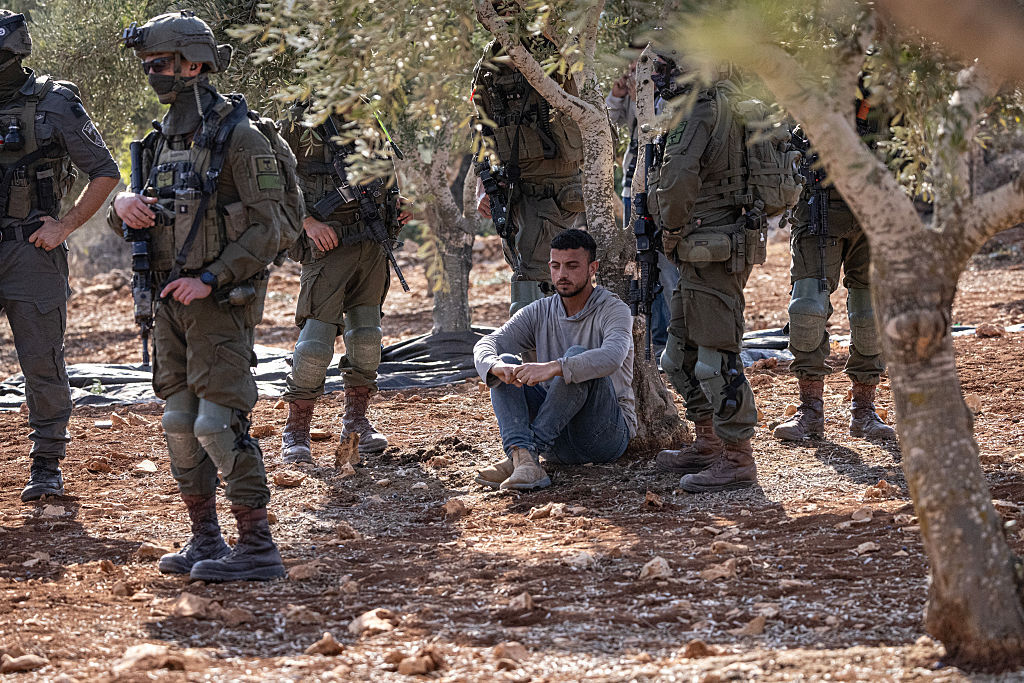
The weekly settlement report issued by the National Bureau for Defending Land and Resisting Settlements revealed that the olive harvest season in the West Bank has turned into a vast arena of conflict. The report explained that settler attacks are no longer limited to farmers and their crops, but have become part of military and colonial policies aimed at restricting Palestinian access to their lands. The National Bureau has documented more than 500 attacks carried out by settlers and occupation forces in about 200 Palestinian communities across various governorates since the beginning of the current season. These violations were concentrated primarily in Jenin, Nablus, Salfit, and Ramallah, where farmers were prevented from harvesting their crops in dozens of locations, and more than 150 cases of crop theft were recorded. The Nablus governorate recorded the highest toll of direct settler attacks, which included the systematic destruction of trees and theft of fruits. These practices led to depriving farmers in dozens of villages of their annual harvest, effectively removing vast agricultural areas from this year’s actual production calculations. The report addressed a fatwa issued by an Israeli rabbi that permits settlers to steal olives from Palestinian lands under the pretext of alleged religious ownership. This fatwa comes within the context of previous fatwas that legitimize the seizure of Palestinian property, such as what was mentioned in the book ‘The King’s Torah,’ which justifies the appropriation of property during times of conflict. The Ministry of Agriculture expected olive oil production to drop this season to about 10,000 tons, after initial estimates indicated 21,000 tons. This sharp decline is due to the prevention of access to lands located behind the wall and near settlements, which threatens the loss of the harvest from half of the cultivated areas. The occupation army implemented new measures preventing farmers from entering lands it classifies as ‘state lands,’ a measure implemented in this form for the first time. The occupation forces also imposed a prior coordination system for entering private lands, which further complicated farmers’ access to their fields and the protection of their crops. The report monitored inflammatory rhetoric prevailing among settlers and officials in the occupation government that portrays the Palestinian olive harvest as a provocative act. This rhetoric is used to justify restrictions imposed on farmers and foreign activists, whom the occupation authorities have begun to describe as ‘anarchists’ to obstruct their supportive activities for Palestinians. The cumulative direct losses to the olive sector resulting from the destruction of trees and the prevention of access to land since 2023 have exceeded $157 million. The loss is not limited to leaving the fruit behind, but also includes the theft of huge quantities and pressing them inside presses in the settlements to market the Palestinian oil for the benefit of the settlers. In the Jenin governorate, the occupation forces strengthened their presence at the Sanur camp by bringing in mobile homes and continuing excavation work at the site. This escalation aims to impose full military control and divide the governorate into isolated enclaves, in preparation for establishing a new settlement in the area. The Jericho and Hebron governorates witnessed the establishment of new settlement outposts aimed at cutting off Palestinian geographical connectivity and imposing a new reality on the ground. Settlers bulldozed lands and sabotaged water lines in Bedouin communities, amidst attempts to Judaize vast areas with direct support from the occupation government. In occupied Jerusalem, colonial plans continue to isolate Palestinian neighborhoods from each other and threaten the Palestinian presence around the Al-Aqsa Mosque. The project to build settlement units in the Sheikh Jarrah neighborhood stands out as a step to besiege the Holy City and isolate its north from its Old City. Former officials in the occupation’s security apparatus warned of the danger of attacks by the ‘Hilltop Youth’ group, which aims to displace Palestinians from their lands. Sources indicated that this group has carried out about 13,000 attacks since October 2023, resulting in the martyrdom of 66 Palestinians. Various governorates witnessed violations including self-demolition of homes in occupied Jerusalem under pressure from the occupation municipality, and the uprooting of hundreds of fruit trees in Hebron. Settlers also continued to pursue shepherds and steal livestock in the Jordan Valley and Bethlehem under the protection of the occupation army. The occupation forces closed agricultural roads with rocks in Ramallah villages to prevent farmers from reaching their fields, which constitute their primary food basket. These measures coincided with physical assaults involving beatings and pepper spray against farmers and activists in Nablus and Salfit to prevent them from completing the harvest season.

Dining and Cooking