
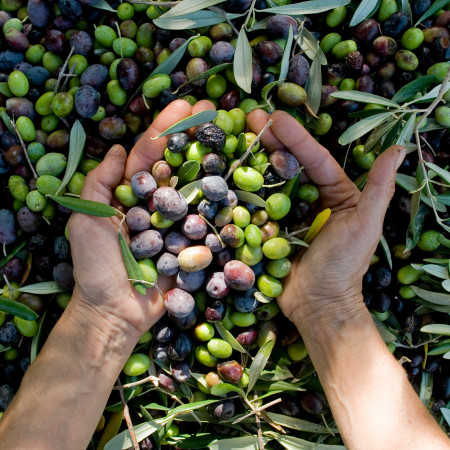
ANKARA. Only preliminary production estimates are available for olives and olive oil in the main producing countries. Turkey has lost extensive market shares in recent years and is calling on the US and the EU to lift restrictions. Trading has become rather difficult.
Only preliminary production estimates available
As the sector approaches the 2026/2027 season, global olive oil production forecasts rank among the most closely monitored indicators. The International Olive Council (IOC) estimates global olive oil production for 2025/2026 at approximately 3.4 million mt, marking a 4% decline on the provisional figure of 3.6 million mt for 2024/2025. An August update from the United States Department of Agriculture (USDA) anticipates a global production figure of approximately 3.3 million mt for 2026/2027, with the European Union’s output estimated at around 2.1 million mt. Other estimates issued in individual countries vary considerably.
In Turkey, the outlook points to a strong “on year” (a year of high yields) for olives. According to the 1st Crop Production Estimate published by the Turkish Statistical Institute (TÜİK) on 21 May 2026, olive production is expected to reach around 3.8 million tons, a 56% increase from the 2.5 million mt recorded last year. For context, the 3.8 million mt produced in 2024 marked the highest output seen to date. These figures refer to the production of olive fruit, while this year’s final volume of olive oil will be determined later, depending on the breakdown between olives destined for oil production versus table consumption, as well as the actual oil yield.
Expectations for other producers in the Mediterranean are more cautious. Manolis Giannoulis, president of the National Olive Oil Intersectoral Organisation in Greece, expects the 2026/2027 production to be in the range of 280,000-330,000 mt. Harvesting generally lasts from late October to February in Greece. In Italy, ISMEA reports that the 2025/2026 season closed with 325,000 mt, marking a 31% increase on the previous year, and states that it is too early to make predictions for the new season.
Based on IOC data, Tunisia became the second largest producer in the world with approximately 450,000 mt in 2025/2026. For the new season, industry reports highlight good flowering and sufficient water capacity in the dams. Yet, production will not range as high as last year. High yield expectations in Spain and Turkey may put pressure on prices in the world market. However, all these figures are preliminary estimates and will change as harvesting progresses.
Difficult trading environment
Turkey anticipates a high yield for both table olives and olive oil in 2026/2027. While the olive sector aims to translate its production capacity into export revenue, it is entering a challenging season, one in which setting specific export targets has proven difficult due to high global yields and the resulting price environment.
Emre Uygun, President of the Aegean Olive and Olive Oil Exporters’ Association, has also confirmed that while the industry hopes to convert the increase in production into export success, rising costs, difficulties in accessing finance and trade barriers in international markets have emerged as significant challenges ahead of the new season. In addition, he stresses that high yields are also anticipated in Spain, Italy and Greece and Tunisia, which leaves the export prospects for Turkish olive oil somewhat constrained.
Exports 28% down
Turkey’s export value of olives and olive oil fell by 28% in January to September 2026 as compared with the same period last year, dropping from USD 381 million to USD 273 million. The export volume also declined by 28%, from 121,000 mt to 87,000 mt. Exports of black olives fell by 14% in volume to 48,100 mt and by 9% in value to USD 127 million. Shipments of green olives declined by 19% to 14,400 mt in terms of volume and by 11% to USD 41.3 million in terms of value.
As olive oil is impacted by global price fluctuations and export restrictions implemented in previous periods the export volume decreased by 53% to 15,700 mt and the export revenue by 48% to USD 82.1 million. Exports of olive pomace oil also declined by 40% in both volume and value, reaching 8,600 mt and USD 22.8 million respectively.
Calls for US and EU to lift restrictions for Turkey
Uygun further notes that customs duties and quota restrictions in the US and EU hinder the growth of Turkish olive and olive oil exports and emphasises the need for regulatory adjustments to improve the sector’s competitiveness.
He calls for the removal of the 12.5% additional customs duty currently applied to Turkish products in the US market. Regarding the EU, he requests that the existing 100 mt olive oil quota be increased to at least 60,000 mt. Touching upon the free trade agreement negotiations with the UK, Uygun states that the Aegean Olive and Olive Oil Exporters’ Association expects “our olives and olive oil to gain access to the UK market with zero customs duties.”
Turkey loses market shares
In addition, the Aydın Commodity Exchange recently organised a meeting to evaluate the challenges facing the olive and olive oil sector in 2026/2027. In their addresses, Aydın Commodity Exchange Chairman Fevzi Çondur and Davut Er, Vice Chairman of the Aegean Olive and Olive Oil Exporters’ Association, highlighted key issues including the decline in exports, high production costs and financing needs along with competition in international markets.
In 2022/2023, Turkey ranked second in global olive oil production with an output of approximately 451,000 mt, generating over USD 700 million in export revenue from the sale of roughly 150,000 mt. This has, however, changed. According to data shared by Er, olive oil exports fell by 60% in volume to approximately 20,000 mt in 2025/2026 and the export revenue dropped by 28% to USD 105.7 million. A decline was also observed in table olives as black olive exports fell by 11% to 69,000 mt, with revenue decreasing by 6% to USD 182 million. Green olive exports declined by 11% to 21,000 mt, with revenue falling by 4% to USD 58 million.
View more
– price charts for edible oils, oilseeds and more
Dining and Cooking