
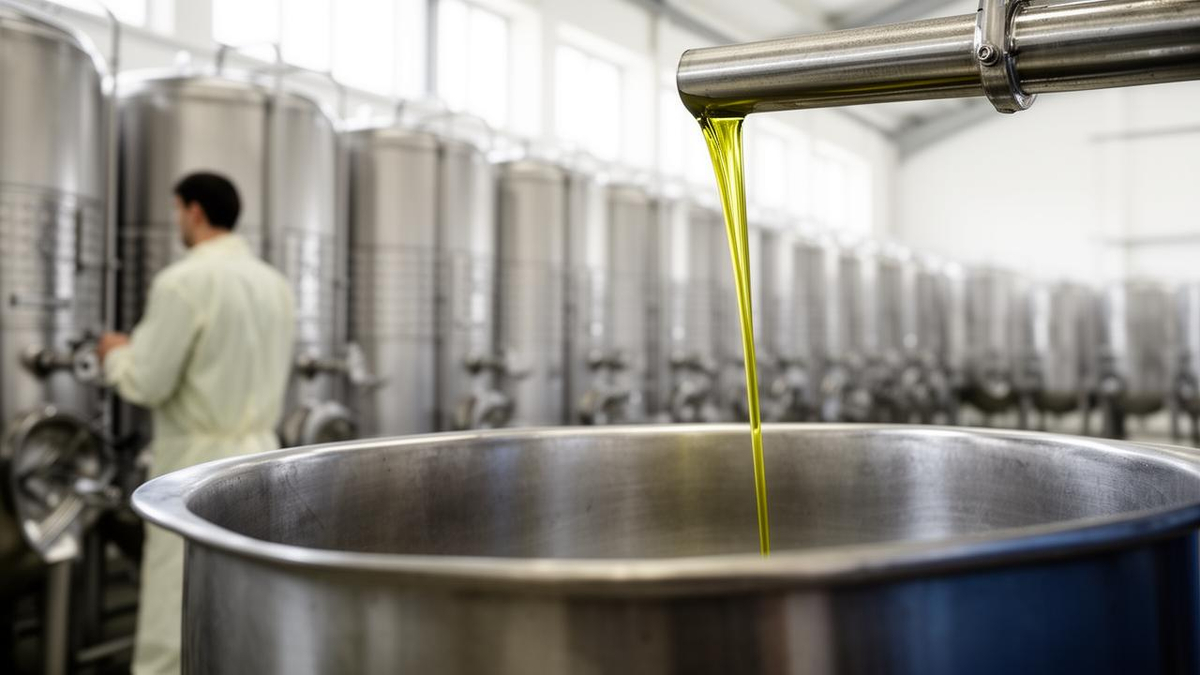
Spain has decided to keep roughly 188,000 tons of olive oil off the market—equal to 12% of the monthly production declared by mills—to stem the slide in prices. The measure, published Friday in Spain’s Official State Gazette (BOE), is the first of its kind adopted by Madrid and will remain in force until September 30, 2027, when the olive oil campaign closes.
The obligation covers the quantities each mill declares it has produced each month; volumes relating to October and earlier months are excluded. The oil may be stored at the producers’ own facilities or at third-party sites. Spain’s Directorate General for Agricultural Production and Markets specified that the stored quantities cannot return to the market before the end of the season.
Justifying the intervention are prospects for an abundant harvest on top of already sizable stocks. According to the resolution, opening inventories stood at 357,040 tons, to which an estimated production of 1,602,596 tons is expected to be added. The mechanism can be triggered when the sum of opening stocks and forecast harvest exceeds the average of the previous six campaigns by at least 20%—a condition that is met this season.
The effect on prices is already visible. In early November, Spanish producers were receiving about 3 euros per kilogram for extra virgin olive oil, versus about 4 euros a year earlier. The price increases that followed drought and heat waves that hit harvests in recent years have thus reversed with the recovery in production.
IndicatorValueMonthly production to be stored12%Volumes off the market (estimate)about 188,000 tonsOpening stocks357,040 tonsForecast production1,602,596 tonsExtra virgin price (early November)about €3/kg (was about €4/kg a year earlier)Share of world productionabout 45%Share of EU productionabout 70%
Note: stock and production data are drawn from the resolution published in the BOE; market shares are estimates from Spain’s Ministry of Agriculture.
The weight of the decision extends beyond national borders. According to the Ministry of Agriculture, Spain accounts for about 45% of world production and 70% of European production, although the shares vary with harvest trends. The country is the world’s leading producer and exporter of olive oil.
On the corporate front, the sector is bracing for a turning point. Dcoop and Acesur have reached an agreement to acquire Deoleo Holding, the subsidiary of the listed Deoleo group, which controls brands such as Carbonell and Hojiblanca. The transaction values the entire company at 520 million euros, including debt, and covers a 91.99% stake, including all of the 50.99% holding held by Deoleo. If the other shareholders tender their shares as expected, the buyers could reach 100%; Acesur has indicated that the two acquirers intend to take equal stakes.
Completion remains subject to regulatory approvals and a vote by shareholders of the listed parent. After the announcement, Deoleo shares closed down 21.1% on Thursday. The deal comes at the end of months of negotiations and after a competing offer submitted by Spain’s Migasa and Italy’s Coricelli.
For producers, the mandatory storage offers temporary support to prices but postpones volumes onto the market that will weigh on the next campaign. For industrial operators, the announced consolidation redraws the ownership structure of the leading brands, while investors are watching the conditions set by antitrust authorities and the outcome of the shareholder vote.
Dining and Cooking