
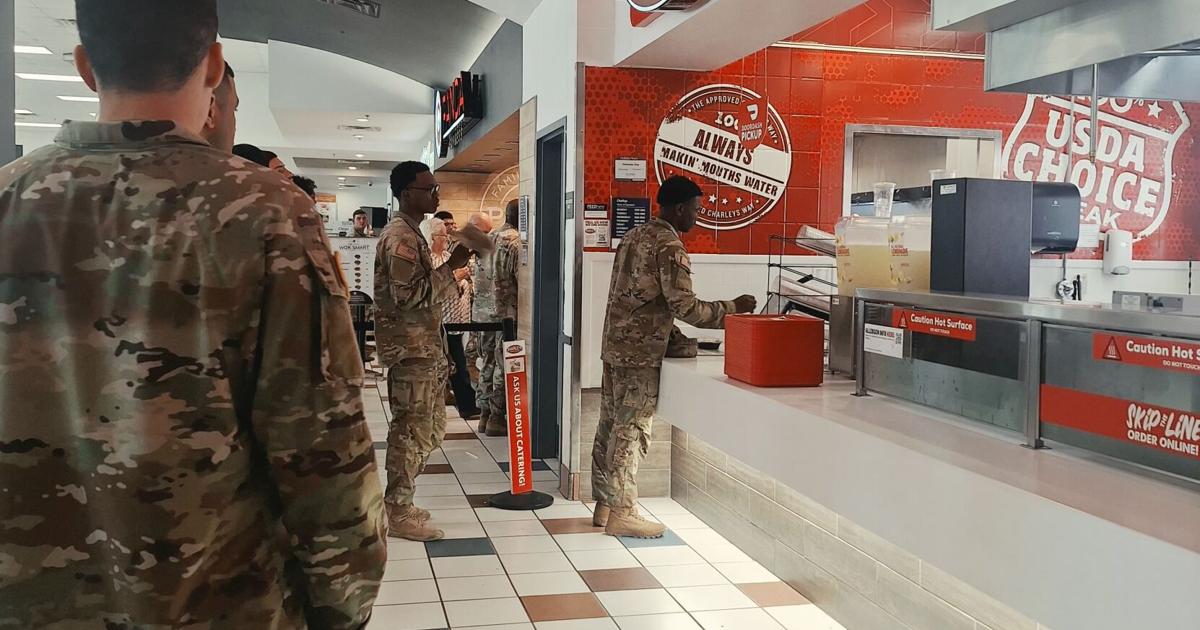

Soldiers stand in line at Charleys Cheesesteaks during the launch of the FEED program Nov. 3 at T.J. Mills Food Court at Fort Hood. Soldiers with Essential Station Messing, or ESM status, can use their entitlements at approved restaurants, including Charleys Cheesesteaks, to purchase select food items for breakfast, lunch and dinner.
Photo by Janecze Wright, Fort Hood Public Affairs
A new initiative is on the menu at Fort Hood.
Army and Air Force Exchange Service, Army Materiel Command and Fort Hood Exchange staff gathered early Nov. 3 at the T.J. Mills Food Court to celebrate the launch of the Flexible Eating and Expanded Dining (FEED) program.
The My Army Post App, or MAPA, makes accessing the FEED program easier for Soldiers. Simply download the app on iOS or Android and follow the steps to access information on participating restaurants, menus and helpful tips. There are currently eight approved restaurants at Fort Hood with select menu items for Soldiers to choose from.
Graphic Courtesy of Fort Hood Public Affairs
The program allows Soldiers to use their meal entitlements to purchase approved menu items at eight different participating Exchange restaurants such as Charleys Cheesesteaks, Starbucks and Subway, expanding access to nutritious food options while making dining more accessible and appealing.
The Army conducted a limited user assessment in August 2025 with Soldiers assigned to 61st Quartermaster Battalion, 13th Armored Corps Sustainment Command, at Fort Hood, garnering feedback about the initiative. This informed the launch of the program at its inaugural location a year later at Fort Stewart, Georgia, with much success.
Left, Brian Roldan-Smith, Fort Hood Class Six store manager, explains how to use the Flexible Eating and Expanded Dining (FEED) program to Pfc. Michael Harris and Pfc. Micah Foster, both with 181st Chemical Company, 2nd Chemical Battalion, 48th Chemical Brigade, during the FEED program launch ceremony Nov. 3 at T.J. Mills Food Court at Fort Hood.
Photo by Janecze Wright, Fort Hood Public Affairs
Now the FEED program is primed to restructure the military dining experience at Fort Hood, offering Soldiers greater flexibility, expanded choices and improved access to nutritious meals that support their health and readiness.
“FEED is the epitome of having our Soldiers be able to use their entitlement and expand their selection and their choices,” said Denise Hunter, senior vice president of the Services and Food Directorate, AAFES, speaking directly to the audience. “Our service members deserve the best. You’re giving them the best. You’re giving them more options than they had, and it’s the best, giving the best.”
Geared toward Essential Station Messing, or ESM, Soldiers, the program requires users to simply scan their common access cards, or CACs, at approved dining locations to purchase select menu items using their meal entitlements.
The initiative is part of the broader Army effort to transform how Soldiers access food and improve the overall dining experience.
The FEED program is just one of the initiatives representing a new era in military dining that reflects a growing emphasis on military dining modernization and innovation.
There are campus-style dining venues, or CSDVs, like 42 Bistro and the future Lone Star Bistro, which feature global cuisines and modern amenities and build upon the contemporary template of its predecessor, grab-and-go meals and expanded food options such as culturally diverse food trucks.
“We are in the middle of a generational overhaul of the Army Food Program,” said Command Sgt. Maj. Jacinto Garza, command sergeant major, AMC. “Soldiers are voting with their feet and taking advantage of the new options and flexibilities. We owe it to our Soldiers — and to taxpayers — to continue our momentum and get this right,” he said.
For Soldiers, the initiative is about having choices that better fit their needs, preferences and daily routines.
“I think it’s great. It gives you a wider array of different types of food you could possibly get with your meal cardholder entitlements and that’s good for Soldiers,” expressed Pfc. Michael Harris, 181st Chemical Company, 2nd Chemical Battalion, 48th Chemical Brigade, and the first Soldier to officially use the program.
“Having the option to go to eat at the DFAC (dining facility) or being able to go to 42 Bistro where they have different types of food, and now you can even go to all your favorite food places and use your meal card. It definitely improves our military life.”
For Soldiers to make the most of their entitlements, they must first understand how the program works, explained Richard Bennett, logistical management specialist, Army Food Innovation and Transformation Team, AMC.
Breakfast, lunch and dinner are provided seven days a week and each meal can be purchased individually or together, Bennett explained.
“Soldiers can get more than one meal at a time,” Bennett said. “If a Soldier wants to exercise his lunch meal during the dinner time frame, he’s more than welcome to do it. If a Soldier happens to miss lunch and makes it over in the dinner hours, he can recoup his lunch and get his dinner. So, it’s a great program for flexibility.”
If Soldiers exceed entitlements for any meal at one location, the next meal must be purchased from the same location. Soldiers can only use their entitlements once per meal, per day, Bennett noted.
Response to the FEED program has been positive, and as the Army continues to evolve its approach to food service, prioritizing Soldiers remains at the forefront.
“We want to meet the Soldiers where they are, where they live, where they work at, because they can’t always get to a dining facility,” Bennett said. “Our goal is accessibility and flexibility. Our goal is to take care of the Soldier.”
Soldiers can download the My Army Post App, or MAPA, on iOS or Android and follow the steps in the infographic to access FEED program menus and information.
Dining and Cooking