
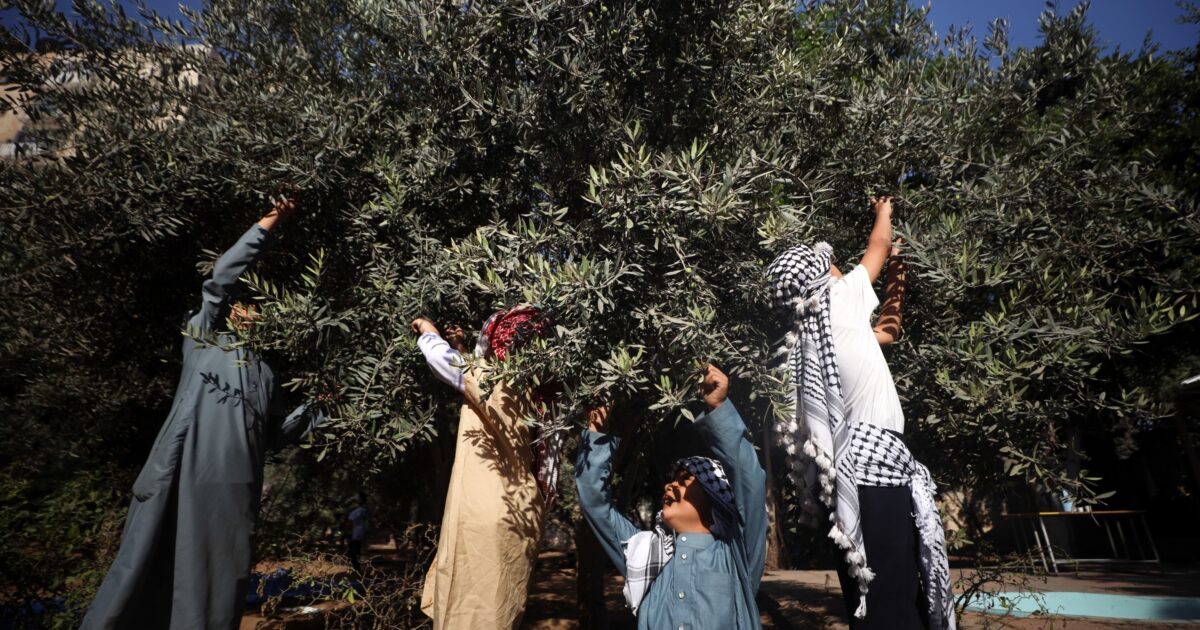
On some mornings, Omar al-Masdar, a 65-year-old olive farmer in central Gaza, manages to harvest only a few of the trees in his grove before Israeli forces start shooting. Situated east of al-Maghazi refugee camp in the Deir-al-Balah governorate, the grove was originally home to around 750 olive trees, planted by al-Masdar’s father about 40 years ago. Now it is split in two by the “Yellow Line,” which separates the Israeli-occupied eastern side of Gaza from the rest of the Strip, and the trees on the occupied side of the line are gone, bulldozed by Israeli forces. When al-Masdar and his sons try to access the remaining trees on the Palestinian side, Israeli forces regularly open fire on them; they try to pick the olives as fast as they can, but they often have to leave the harvested olives on the ground until the next day so as not to further risk their lives.
Most of the attention on this year’s Palestinian olive harvest has focused on the occupied West Bank, where settler attacks on farmers have surged. But in Gaza, the olive harvest is also under attack: The genocide has upended every step of the season, destroying around 90% of the Strip’s olive trees, and starving the surviving groves of water and pesticides. The handful of olive presses that remain in use—down to nine from 39 that were operating before the war—are running on erratic generators and hampered by shortages of spare parts, oils to maintain the equipment, and diesel to run them.
The impact on olive farmers’ livelihoods has been ruinous: According to Gaza’s Ministry of Agriculture, the number of farmers working in the olive sector has fallen from about 20,000 before the genocide to about 1,000. And the combination of Israel’s restrictions on the entry of agricultural supplies along with a shattered economy has forced olive farmers to cut down their fruitless trees and sell them as firewood to buy food for their families.
Olive farmers also continue to lose their land to persistent Israeli encroachment. The Yellow Line, implemented as part of the ceasefire in October 2025, was supposed to leave a little under half of the area of the Strip on the Palestinian-controlled side. But a year into the ceasefire, Israel has kept moving the line westward, swallowing farmland that survived the bombing and shutting farmers out of their fields. Between October 2025 and June 24, 2026, farmland across the Gaza Strip that was both undamaged and accessible shrank from about 1,485 acres to about 1,107 acres, according to a UN assessment, a loss primarily caused by the shifting of the Yellow Line. Around 97% of Gaza’s farmland is now inaccessible, damaged, or both, and Israel is seeking to take over additional land from the roughly 60% of the Gaza Strip it already controls.
In mid-October, when Israel moved the line again, it took more of al-Masdar’s land with it. And because Israeli forces keep opening fire when he goes to pick his olives, al-Masdar has managed to harvest only eight trees this season. “The trees outside the Yellow Line, the ones that are supposed to be safe for us to go and pick, still have the olives on them, and no one can pick them,” al-Masdar said. “They fall to the ground and the worms eat them.”
The war had already left his olive trees in a vulnerable state; for three years, he told me, he could neither water the grove nor spray it against pests. The Israeli army bulldozed every nearby well, leaving the trees dependent on rain alone. Now, al-Masdar can no longer support himself and his family as an olive farmer: There is no work, and aid either fails to arrive or is not enough to live on, he said. “The hunger sticks to us, even in what they call a ceasefire.”
Mustafa Hamad, who had his own olive trees in Jabalia before the genocide, lost his entire grove after the Israeli military leveled his neighborhood. The trees had been planted by his grandfather 50 years ago, but now there are none left to pick. Instead, he, like many other olive farmers in Gaza, has to harvest someone else’s trees as a day laborer.
On a recent night, Hamad, 30, sat in a circle with 17 other men inside a darkened olive press in al-Zawayda, central Gaza. They sipped coffee and tea made by the press owner, Bassem Abu Zayed, and chatted in the mild October air while they waited for the sun to rise, or for the generator to come back to life. Every time it did, the farmers jumped up and formed a line to get their olives pressed. Minutes later, it would cut out again.
Hamad kept watch over the sacks of olives that stood against the wall in front of them, filled with around a ton of fruit he and his seven brothers had picked. The olives were from land owned by Ahmed Bashir, 70, in the al-Baraka area of Deir al-Balah. Hamad and his brothers each earned 50 shekels (about $17) a day for their work harvesting the trees—not even enough to provide lunch for his wife and eight children, he said.
Bashir was facing his own struggles, having had to hire Hamad and his brothers after his 30-year-old son, who used to harvest most of his olives, lost his leg above the knee in an Israeli airstrike early this year. Bashir’s grove is far from the Yellow Line, but his trees are parched; without enough diesel to power drip lines running to each tree, the olives are shriveling, and the oil that comes from them is pale yellow and sharp, with what farmers call “the taste of thirst.”
Hamad spent four days and nights at the press with Bashir’s olives, first because the generator had to be fixed—it had broken down after being fed adulterated oil that Abu Zayed had unknowingly bought from a trader—and then because the power kept cutting out. When the olives finally went through the press on the fourth day, Bashir offered to pay Hamad for guarding the sacks. Hamad refused to take a single shekel, so Bashir poured two liters of the new oil into bottles, and insisted until Hamad took them home.
Dining and Cooking