

The Australian Government’s revised Working Holiday Maker visa policy was largely welcomed by Australia’s drinks trade as an improvement on the reforms announced in September. However, the changes are still expected to have a significant impact on agricultural and hospitality workforces in regional locations across Australia.
New modelling provided by Australian Migration Lawyers estimates that Australian farms will still face an annual shortfall of about 6,700 backpacker workers following the revision.
Four council areas tied to wine-producing regions are expected to be among the 10 farming towns most impacted by the changes.
This includes council areas directly linked to the Murray Darling, Swan Hill and Riverland – three embattled warm inland wine regions which collectively accounted for more than 50 per cent of Australia’s wine production in vintage 2026.
The affected wine regions are highlighted in dark blue in the graph below:
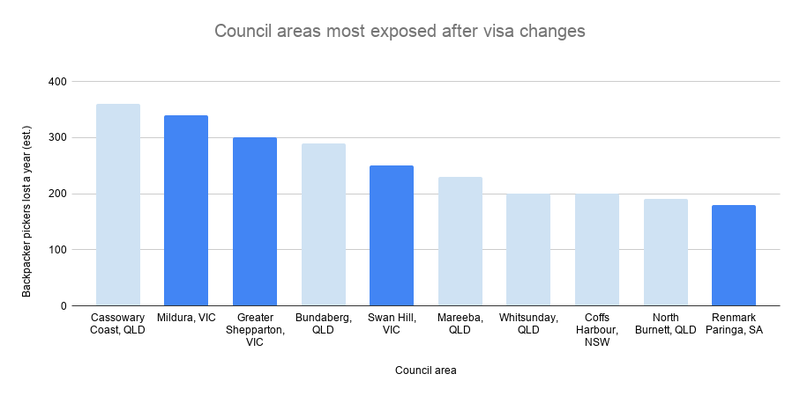
Source: Drinks Trade graph using Australian Migration Lawyers data
According to Australian Migration Lawyers, Mildura, in Victoria’s north-west and linked to the Murray Darling wine region, is expected to lose 340 backpackers a year following the visa changes, resulting in a crop value exposure of $407 million – a figure which includes all crops, not only wine.
Ranked third, Greater Shepparton is expected to suffer a workforce loss of 300 backpackers and crop value exposure of $359 million, potentially affecting access to labour in Victoria’s Goulburn Valley wine region.
Swan Hill, about 200km south-east of Mildura, will lose 250 backpackers, impacting the Swan Hill warm inland wine region, which is typically combined with the Murray Darling in Wine Australia’s data. In vintage 2026, the Murray Darling – Swan Hill region crushed 237,316 tonnes, equivalent to one-fifth of Australia’s total crush, despite being 28 per cent down year-on-year.
Renmark Paringa, the council area linked to the Riverland, Australia’s largest region by volume accounting for 30.8 per cent of Australia’s 2026 wine crush volume, is expected to lose 180 backpackers per year, with $220 million in crop value exposed.
The Australian Migration Lawyers modelling comes after the Department of Agriculture, Fisheries and Forestry told Senate estimates it had not completed modelling of the potential impact on harvests.
The law firm estimates that Queensland will lose an estimated 2,200 backpacker farm workers a year, more than any other state, followed by Victoria at about 1,700 and New South Wales about 1,100.
Shortages in Coffs Harbour, ranked eighth, may have a flow-on impact on the nearby Northern Rivers wine region, while Mareeba, in Queensland’s Atherton Tablelands, ranked sixth, is also home to a number of boutique wineries.
Australian Migration Lawyers’ leading lawyer Perry Q. Wood offered the following advice for business owners to share with workers on their first Working Holiday Maker visa:
“If you’re on a first working holiday visa and want to stay longer, keep doing your specified work and keep every payslip, because the evidence still matters even with a ballot. Don’t make plans on the assumption you’ll get a second year until you have it in writing.”
Learn more about the report and about Australian Migration Lawyers here.
Alternatively read more about the revisised visa reforms in Drinks Trade’s original coverage,‘Common sense’ changes to backpacker visa reforms welcomed by the drinks trade.
AML Data: The council areas most exposed after the changes 
Dining and Cooking