
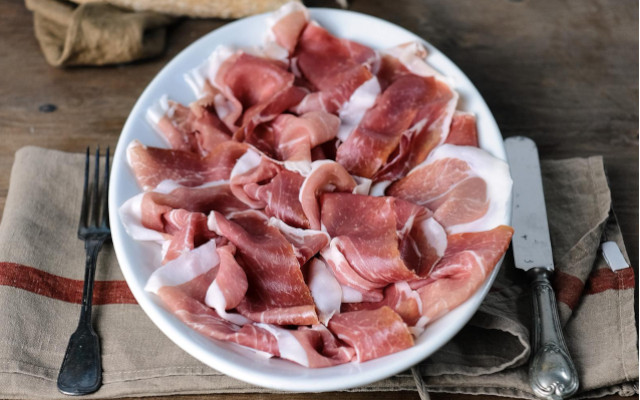
The aged Italian cured ham Made in Italy — outside the protection regimes for Geographical Indication (PDO/PGI) — represents a significant share, though less celebrated by the media, of national cured meat production. Alongside protected designations such as Parma PDO Cured Ham e San Daniele PDO Cured Ham, there is a broad sector of Italian aged cured hams, produced in different regions in compliance with rigorous national sector regulations, intended for both the domestic market and export.
This category captures differentiated consumer segments by price, formats (whole, boneless, slices, pre-sliced) and distribution channels (retail, HoReCa, collective catering), contributing to the international competitiveness of Italian cured meat sector and to the enhancement of local production chains that do not fall within PDO/PGI circuits.
Market analysis: the record of Italian exports in 2024
According to the data presented at the Annual Meeting of ASSICA (Meat and Cured Meat Industrial Association, member of Confindustria) held in Brussels on 26 June 2025, and preliminary data ISTAT, the Italian cured meats sector closed 2024 with record production and export results, against a decline in domestic consumption.
the overall production of cured meats in Italy it has reached 1.165 million tons (+1.2% compared to 2023), for a value of approximately 9.463 billion euros (+3.2%). In the specific sector of cured raw hams, production stood at 271,700 tons (+1.9%), with an estimated value of 2.521 billion euros (+5%). Raw and cooked hams as a whole represent 48.6% of total production in quantity and 51.1% in value.
I internal consumption of cured meats decreased slightly, reaching 984,000 tonnes, (-1.3%), with a per capita consumption of 16.5 kg/year, i.e. 45 g/day (-1.3%). The share of domestic consumption of raw ham corresponds to 21% of the total.
On the front of export, the sector has instead reached a historic milestone: total exports of cured meats have exceeded 2.378 billion euros (+9.5% in value) for a total of 229,888 tonnes (+12.9%). Exports of cured raw hams they achieved 1.009 billion euros (+8.5%), with 74,297 tonnes exported (+8.2%). Growth was driven by the European Union (50,618 t, +9.4%) and supported on some non-European markets.
From ancient Rome to today: the evolution of the ‘perexsuctum’
the history of cured ham Italian has its roots in pre-Roman civilizations. The first traces of salting the pork leg date back to Padanian Etruscans settled between Parma and Mantua (6th-5th century BC), which inaugurated the production chain then inherited from the Romans. The name The product itself reveals this continuity: ham derives from the Vulgar Latin perexsuctum (or perexutus), meaning ‘dried up’, indicating the dehydration that transforms the fresh leg into a stable food at room temperature.
Cato the Censor, in De Agricultura (2nd century BC), describes with precision the salting and aging techniques for pork thighs, substantially identical in their fundamentals to those still codified today. Pliny the Elder, in the Naturalis Historia, praises the quality of Norcia cured meats. The famous via ‘Panisperna’ (panis = bread, perna = pork leg), in the heart of Rome, testifies to the centrality of the product in the urban diet of antiquity.
In the Middle Ages, the Lombards intensified pig farming and refined the maturing techniques, resulting in the emergence of the most suitable territories: Parma, Friuli and Mantua. The Corporations of lard producers codify the production processes, definitively separating raw ham and cooked ham. In the Renaissance, aged raw ham dominated princely tables and appeared in gastronomic treatises. The industrial production it developed starting from the nineteenth century, in parallel with the birth of the first structured ham factories in the Po Valley. The first legal recognition of Parma Ham dates back to 1970, followed by the European PDO in 1996.
The new regulation: what the DM 8 August 2025 establishes
The inter-ministerial decree of 8 August 2025 — containing the ‘discipline of the production and sale of certain delicatessen products’ — establishes the requirements that a Made in Italy product must comply with to be presented and marketed in Italy as aged raw ham. This is a real ‘ex lege’ specification, also binding for non-GI products.
Definition
Without prejudice to the specific provisions established by the production regulations for aged raw hams recognized as Geographical Indication pursuant to Regulation (EU) 2024/1143, the generic name ‘cured raw ham’ is reserved for aged, non-smoked meat product obtained from pork thighs through traditional technique, based on dry salting and aging at controlled temperature (Decree 8.8.2025, article 11).
the raw material it consists of whole pork legs with non-greasy white external fat, moderate marbling and pale rinds with no significant anomalies. Legs from sows, PSE (pale, soft, exudative) or DFD (dark, firm, dry) meat, nor legs with bone fractures or without hips are not permitted. The use of frozen legs is permitted, provided that the labeling requirements set out in the regulation are applied. (EU) no. 1169/2011 (DM 8.8.2025, art. 11).
Permitted ingredients
In addition to food salt (including iodized salt), the decree permits: pepper, truffle, flavourings, simple sugars (dextrose, fructose, sucrose), nitrites and nitrates, potassium chloride and sodium substitutes, antioxidants and acidity regulators (lactic, acetic, citric acid and their salts). Other additives are prohibited, except those permitted by Regulation (EC) No. 1333/2008 where there is a genuine technological need (DM 8.8.2025, art. 12).
Processing stages
The production process of aged raw ham is broken down into the following stages:
salting: sprinkling with dry salt. Immersion salting and brine injection are prohibited;
resting: cold drying after removal of residual salt; minimum duration 40 days (55 days for thighs over 11 kg);
washing: removal of surface salt residues with lukewarm water;
drying: dehydration of the surface in controlled humidity and temperature conditions. Smoking and accelerated maturation techniques are prohibited.
larding: application of a mixture of suet, rice flour, salt, pepper and flavorings to limit excessive dehydration of the lean meat.
Ageing: maturation at controlled humidity and temperature; Stewing, temperatures above 22°C and accelerated maturation are prohibited. ‘The finished, intact product is stable at room temperature’ (DM 8.8.2025, article 13).
Minimum weight and process duration
The dry-cured ham aged, ready for consumption, has a minimum weight of 6 kg with bone. The minimum duration of the production process is 7 months (9 months for hams with a final weight exceeding 8 kg. DM 8.8.2025, article 14).
Physical-chemical and organoleptic characteristics
the internal lean fraction (biceps femoris muscle) is defined by the following average values:
product salt × moisture
Aged raw ham must also present the following organoleptic characteristics:
‘uniform red color when cut free from infiltrations, fissures or cavities and presents aroma and flavour typical of aged product, with moderate salt perception and absence of rancid notes, as well as soft consistency, non-fibrous when chewed’ (DM 8.8.2025, article 15).
The product can be marketed whole, boned, in slices, sliced or in other forms (e.g. diced, ‘matchstick’. Ministerial Decree 8.8.2025, article 16).
Biochemistry of quality: how aging transforms meat
The production process of aged raw ham activates complex biochemical reactions which determine its sensory profile and nutritional and functional properties:
during the salting, drying and ageing phases, muscle proteins and fats are progressively hydrolysed by the action of endogenous enzymes – cathepsins (B, D, H, L), calpains, aminopeptidases, carboxypeptidases – generating a wide variety of low molecular weight peptides and free amino acids which contribute to the development of the aroma, umami flavor and tenderness of the slice (Harkouss et al., 2015); the’proteolysis index (non-protein nitrogen to total nitrogen ratio) is the fundamental technical parameter to assess the degree of maturation: optimal levels (
the reduction of water activity (a~w~) during ageing is also the main mechanism of microbiological safety: salt concentration in tissues, combined with progressive dehydration, inhibits pathogen growth without the need for heat treatments or accelerants, nor preservative additives
Temperature, salt content and humidity are the key process factors that determine the final quality of the product:
the interaction between proteolysis, lipolysis (lipid oxidation) and muscle structure, controlled by the environmental maturing conditions, defines the aromatic intensity, tenderness and color of the slice (Harkouss et al., 2015); the proteolysis extended enzymatic activity during aging further increases protein bioavailability compared to fresh meat, making aged raw ham one of the most easily assimilable protein foods of animal origin.
The ban on the use of accelerated maturation techniques, established by the Ministerial Decree of 8 August 2025, is therefore functional to the organoleptic and nutritional quality of Made in Italy cured raw ham.
Nutritional profile and benefits of cured ham
Based on CREA Food Composition Tables CREA (Research Centre for Food and Nutrition), 100 grams of aged raw ham provide on average:
fats: 13.7 g, of which saturated fatty acids 4.84 g, monounsaturated 6.35 g and polyunsaturated 1.88 g; salt: 6 g (to be verified case by case on the label of individual products).
As for trace elements, aged raw ham is:
rich in potassium: 621 mg per 100 g, equal to 31.1% of the Nutritional Reference Value (2000 mg) indicated in Annex XIII to Regulation (EU) No. 1169/11; Source of Phosphorus: 196 mg, equal to 28% of the NRV (700 mg); Source of Selenium: 15 μg, equal to 27.3% of the NRV (55 μg); Source of Zinc: 2.1 mg, equal to 21% of the NRV (10 mg).
It is also highlighted the generous supply of aged raw ham in vitamins of group B:
extraordinarily rich in vitamin B6: 1 mg, equal to 71.4% of the NRV (1.4 mg);
rich in thiamine (vitamin B1): 0.58 mg, equal to 52,7% of the NRV (1.1 mg);
rich in niacin (vitamin B3): 5.45 mg, equal to 34.6% of the NRV (16 mg); Source of Vitamin B12: 0.38 μg, equal to 15.2% of the NRV (2.5 μg).
The sodium content is high (on average 2400 mg/100 g), a physiological consequence of traditional salting: this aspect requires moderate consumption as part of a balanced diet, in particular for subjects with arterial hypertension or impaired renal function.
The systematic review by Jiménez-Colmenero et al. (2010), published in Meat Science, remains the fundamental reference for nutritional composition of raw ham and for strategies to improve the nutritional profile of the product.
In the context of Contemporary Mediterranean diet, cured raw ham can be included as a quality protein food, favoring small portions (40-60 g) and pairings with fresh vegetables, legumes and whole grains. Attention to sodium remains the main recommendation for conscious consumption.
Micronutrient focus: vitamins and minerals
Vitamin B6 1.0 mg 71,4% Rich in Vitamin B1 (thiamine) 0.58 mg 52,7% Rich in Vitamin B3 (niacin) 5.45 mg 34,6% Rich in Potassium 621 mg 31,1% Rich in Phosphorus 196 mg 28,0% Source of Selenium 15 μg 27,3% Source of Zinc 2.1 mg 21,0% Source of Vitamin B12 0.38 μg 15,2% Source of
Bioactive peptides: functional and antihypertensive properties
Recent research has shown how the proteolysis that occurs during the aging process of raw ham generates bioactive peptides with significant functional properties:
research published in Food Research International identified and quantified over 9,000 peptide sequences in raw hams from Parma, Teruel and Belgium, detecting inhibitory activity of the ACE (angiotensin-converting enzyme) enzyme above 70% in the fractions studied, with a potential antihypertensive effect (Mora et al., 2016); a randomized clinical study published in Journal of Functional Foods demonstrated beneficial effects of regular consumption of raw ham rich in bioactive peptides on cardiovascular markers, including the reduction of systolic blood pressure and the improvement of inflammatory indicators in subjects with risk factors (Montoro-García et al., 2017); a systematic review published in International Journal of Molecular Sciences further documented the role of di- and tripeptides in modulating antioxidant, anti-inflammatory and antidiabetic response in in vitro, in vivo and preliminary human trials (Heres et al., 2023); the most recent scientific review, published in Antioxidants, confirms that bioactive peptides from aged raw ham represent an emerging frontier also with a view to the development of nutraceutical ingredients (Hernández Correas et al., 2025).
User guide: combinations and formats for modern consumption
The versatility of aged raw ham is expressed in a vast repertoire of uses. Raw, it is the star of appetizers, mixed boards and aperitifs; it is classically paired with unsalted bread (Tuscan unsalted bread, Romagna piadina), Focaccia, Fresh fruit (Melon, Pears, figs, Grapes) and soft cheeses. During cooking, it wraps white meats and vegetables (rolls), enriches first courses, gourmet pizzas and rustic savory pies.
I Modern consumption reflect new food trends: raw ham finds space as a topping for protein bowls, complete salads, premium street food and as an ingredient in ‘fusion’ recipes. For i International markets, the product adapts to ready-to-eat formats, single-dose portions and innovative packaging (skin trays, flow-pack) functional to quality fast service.
Conclusions
The Italian aged cured ham is a strategic asset of national cured meat production, often underrepresented in the media narrative of Food Made in Italy. The regulatory definition updated by Ministerial Decree 8 August 2025 strengthens the clarity of denomination, consumer protection and fair competition, enhancing the authentic production method — dry curing and temperature-controlled ageing — even outside PDO/PGI circuits.
In a market context marked by Cost pressures (raw materials, energy, PSA), from a contracting domestic market and from international demand sensitive to the quality/price ratio, this category can play a key competitive role — provided investment is made in informational transparency, constant quality, research on functional peptides and innovative formats, maintaining a firm link with the original production method.
Dario Dongo
Credit cover: Istituto Valorizzazione Salumi Italiani
References
Regulatory and institutional sources
CREA – Council for agricultural research and analysis of agricultural economics (2023). Nutritional value of Italian cured meats. Rome: CREA – Food and Nutrition. Nutritional value of Italian cured meats
Market and sector sources
Peer-reviewed scientific studies
Harkouss, R., Astruc, T., Lebert, A., Gatellier, P., Loison, O., Safa, H., Portanguen, S., Parafita, E., & Mirade, P.-S. (2015). Quantitative study of the relationships among proteolysis, lipid oxidation, structure and texture throughout the dry-cured ham process. Food Chemistry, 166, 522–530. https://doi.org/10.1016/j.foodchem.2014.06.013
Hernández Correas, N., Liceaga, A. M., Abellán, A., Muñoz-Rosique, B., & Tejada, L. (2025). Bioactivities derived from dry-cured ham peptides: A review. Antioxidants, 14(8), 1011. https://doi.org/10.3390/antiox14081011
Heres, A., Mora, L., & Toldrá, F. (2023). Bioactive and sensory di- and tripeptides generated during dry-curing of pork meat. International Journal of Molecular Sciences, 24(2), 1574. https://doi.org/10.3390/ijms24021574
Montoro-García, S., Zafrilla-Rentero, M. P., Celdrán-de Haro, F. M., Piñero-de Armas, J. J., Toldrá, F., Tejada-Portero, L., & Abellán-Alemán, J. (2017). Effects of dry-cured ham rich in bioactive peptides on cardiovascular health: A randomized controlled trial. Journal of Functional Foods, 38, 160–167. https://doi.org/10.1016/j.jff.2017.09.012
Mora, L., Escudero, E., & Toldrá, F. (2016). Characterization of the peptide profile in Spanish Teruel, Italian Parma and Belgian dry-cured hams and its potential bioactivity. Food Research International, 89(Pt 1), 638–646. https://doi.org/10.1016/j.foodres.2016.09.016
Petričević, S., Marušić Radovčić, N., Lukić, K., Listeš, E., & Medić, H. (2018). Differentiation of dry-cured hams from different processing methods by means of volatile compounds, physico-chemical and sensory analysis. Meat Science, 137, 217–227. https://doi.org/10.1016/j.meatsci.2017.12.001

Dario Dongo, lawyer and journalist, PhD in international food law, founder of WIISE (FARE – GIFT – Food Times) and Égalité.
Dining and Cooking