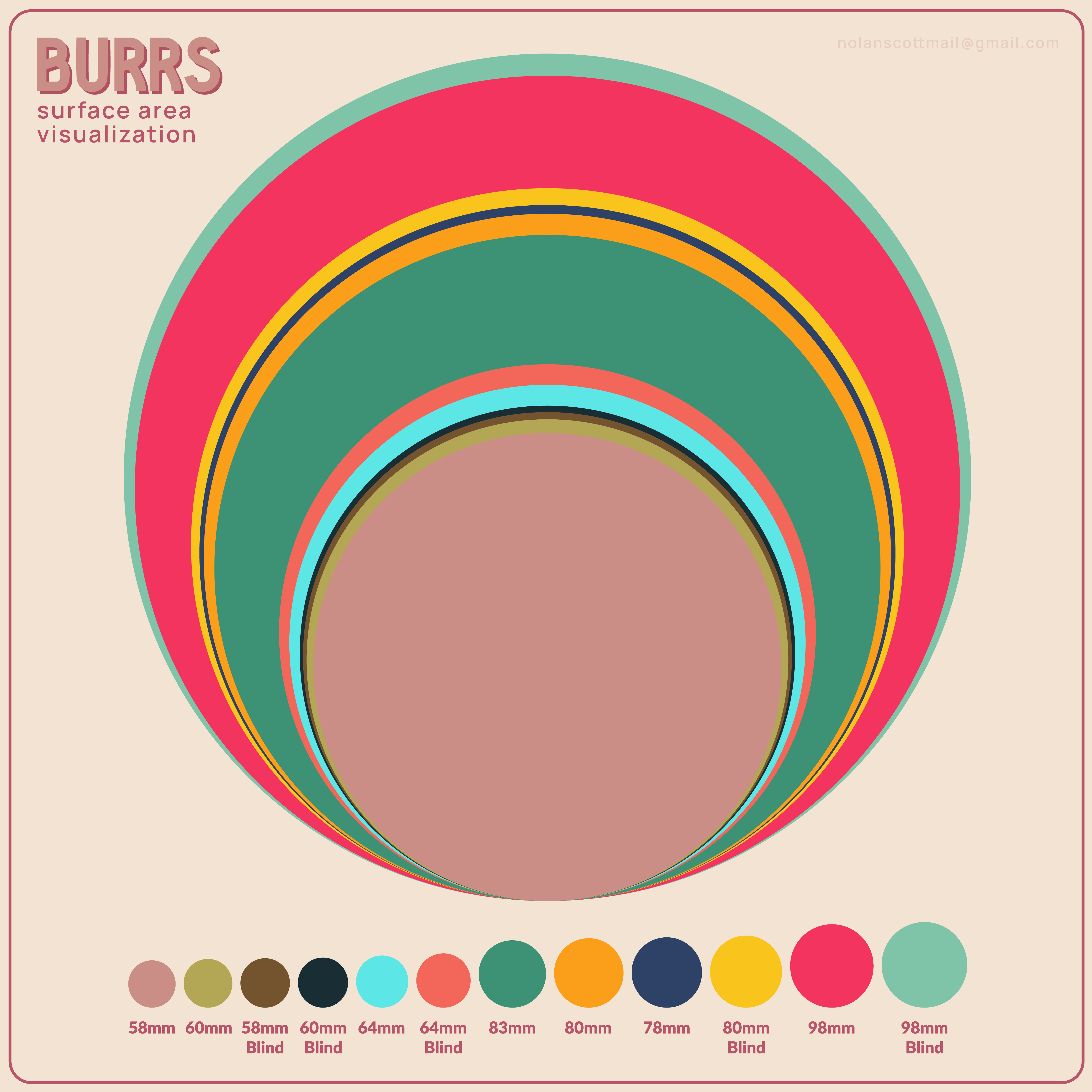
Worked on measuring the surface area of burrs with Lance Hedrick and another Discord member named Matt last night. I wrote up the results and some key takeaways and created a fun graph to visualize the size comparison. Please note that this does not factor in geometry, just total surface area. Incredibly nerdy, but it was fun!
– 83mm Italmill (SSP is the same, 3 screw) 3269.27mm sq.
– 98mm SSP HU (3 screw) 5018.72mm sq.
– 98mm Compak (blind) 5291mm sq. (5.4%~ increase over non-blind)
**Notable takeaways:**
– 83mm burrs have a large center hole that make them smaller than 78mm and 80mm burrs. For example, 78mm burrs are 9.2% larger than 83mm burrs despite the difference in diameter.
– 78mm burrs have a small interior hole and only two screws which gives them more cutting surface than non-blind 80mm burrs and 83mm burrs. For example, 78mm burrs are 2.6% bigger than 80mm burrs with screws and 80mm Weber blind burrs are 4.5% larger than 78mm burrs.
– 78mm burrs are a whopping 81.8% bigger compared to 64mm burrs with screws.
– The 58mm Pietro blind burrs are surprisingly close in size to popular 64mm burrs (3 screw), being only 11.5% smaller.
– Screw holes (assuming the same number of screws) make less impact on larger burrs percentage-wise.
– 98mm burrs are BIG, but the largest jump in cutting surface comes from upgrading from 64mm to 78/80mm burrs. For example, 98mm blind burrs are 41.3% larger than 80mm blind burrs, but the jump from 64mm blind burrs to 78mm is 68.2% or 81.8% compared to 64mm with screws.
cssxssc
Great work! Very cool!
Horse8493
>- 78mm burrs are a whopping 81.8% bigger compared to 64mm burrs with screws.
5000 panicking people are now rushing to update their pledge from the sculptor 064 to the 078 🤣
Fruggles
This is great (and some wild values that I didn’t even think would compare like this!)
lance-hedrick
💥💥💥
BaseCommanderMittens
55 not even represented, like I’m some kind of small-surface-area-burr degenerate.
TheMaxLengthUsername
Make it into a shirt with a to-scale coffee bean in the center!
Confused4783
Is there a benefit to larger cutting surface other than quicker grinding? Do larger burrs produce more or less fines than smaller burrs?
Would like to see the conical burrs on here to fit comparison!
highball0
I would argue that screw heads are in some way contributing to grinding and are not empty space in terms of surface area as you seem to have counted them.
The screw head occupies space on a cutting surface and therefore must contribute to at least a crushing effect, if not possibly a cutting/shearing depending on the head type. Obviously not as effective as a but, but certainly not zero either. I don’t think it’s negligible space
atomatoisagoddamnveg
I appreciate the work that went into making this and that it’s a well designed visual aid, but I wonder if it is misleading.
Here’s my reasoning: from the beans perspective the total area of a burr is irrelevant, just the path the bean takes as it is grounded up is important. I can’t begin to guess what the bean path looks like, maybe it shoots almost straight out like a line, maybe it’s smeared over the whole of the burr. If it’s a straight line then the bean path is basically the radius of the burr times the diameter of the bean, but if it’s maximally smeared out on the burr then this graphic almost applies (burrs are annuli, I.e have a hole in the center). The truth is probably somewhere in the middle which would mean this graphic overdramatizes the differences.
Successful_Trash_409
“my burrs are bigger than yours” Just get on and drink your coffee as long as you’re enjoying it!
chazam92
I guess this is another kind of coffee rabbit hole
camelfarmer1
This just in – circles with bigger radii have higher surface area!
techdregs
What’s also interesting about burrs is that surface area doesn’t actually mean that the burr is faster or gentler on the bean. That also has to include RPM, and thus, like in machining: surface speed.
Larger burrs will spin faster at the outer edge than smaller burrs for a given RPM, so some people may think that using a low RPM large burr is “gentle”, but given the added circumference, it may not actually be the case. Further, the surface speed of the grinding face changes from the inner portion of the burr to the outer rim.
icecream_for_brunch
I don’t get how this is surface area since the actual surface (the teeth of the burrs) isn’t included in the calculation. This is treating the surface as a smooth plane, which it isn’t.

17 Comments
Worked on measuring the surface area of burrs with Lance Hedrick and another Discord member named Matt last night. I wrote up the results and some key takeaways and created a fun graph to visualize the size comparison. Please note that this does not factor in geometry, just total surface area. Incredibly nerdy, but it was fun!
Lance’s post for reference: [https://www.instagram.com/p/Cq-ozbdNtx_/?utm_source=ig_web_copy_link](https://www.instagram.com/p/Cq-ozbdNtx_/?utm_source=ig_web_copy_link)
– 58mm SSP (3 screw) 1613.91mm sq.
– 58mm Pietro B-Modal (blind) 1760.9mm sq. (9.1%~ increase over non-blind)
– 60mm SSP Silver Knight (2 screw) 1709.74mm sq.
– 60mm (blind) 1807.78mm sq. (5.7%~ increase over non-blind)
– 64mm Italmill (SSP is the same, 3 screw) 1963.39mm sq.
– 64mm ITOP 64 (blind) 2122.6mm sq. (8.1%~ increase over non-blind)
– 78mm Timemore Turbo (2 screw) 3569.56mm sq.
– 80mm SSP HU (3 screw) 3479.97mm sq.
– 80mm SSP Lab Sweet (blind) 3743.7mm sq. (7.6%~ increase over non-blind)
– 83mm Italmill (SSP is the same, 3 screw) 3269.27mm sq.
– 98mm SSP HU (3 screw) 5018.72mm sq.
– 98mm Compak (blind) 5291mm sq. (5.4%~ increase over non-blind)
**Notable takeaways:**
– 83mm burrs have a large center hole that make them smaller than 78mm and 80mm burrs. For example, 78mm burrs are 9.2% larger than 83mm burrs despite the difference in diameter.
– 78mm burrs have a small interior hole and only two screws which gives them more cutting surface than non-blind 80mm burrs and 83mm burrs. For example, 78mm burrs are 2.6% bigger than 80mm burrs with screws and 80mm Weber blind burrs are 4.5% larger than 78mm burrs.
– 78mm burrs are a whopping 81.8% bigger compared to 64mm burrs with screws.
– The 58mm Pietro blind burrs are surprisingly close in size to popular 64mm burrs (3 screw), being only 11.5% smaller.
– Screw holes (assuming the same number of screws) make less impact on larger burrs percentage-wise.
– 98mm burrs are BIG, but the largest jump in cutting surface comes from upgrading from 64mm to 78/80mm burrs. For example, 98mm blind burrs are 41.3% larger than 80mm blind burrs, but the jump from 64mm blind burrs to 78mm is 68.2% or 81.8% compared to 64mm with screws.
Great work! Very cool!
>- 78mm burrs are a whopping 81.8% bigger compared to 64mm burrs with screws.
5000 panicking people are now rushing to update their pledge from the sculptor 064 to the 078 🤣
This is great (and some wild values that I didn’t even think would compare like this!)
💥💥💥
55 not even represented, like I’m some kind of small-surface-area-burr degenerate.
Make it into a shirt with a to-scale coffee bean in the center!
Is there a benefit to larger cutting surface other than quicker grinding? Do larger burrs produce more or less fines than smaller burrs?
Instantly reminded me of [this.](https://1.bp.blogspot.com/-T7RSRxlAzoY/XbvijroxJ-I/AAAAAAAATBo/TrdxTflC7281YokWyTs7-wg6B-lD-2oygCLcBGAsYHQ/s1600/73280055_10156669465677671_4099400783424913408_o.jpg)
Would like to see the conical burrs on here to fit comparison!
I would argue that screw heads are in some way contributing to grinding and are not empty space in terms of surface area as you seem to have counted them.
The screw head occupies space on a cutting surface and therefore must contribute to at least a crushing effect, if not possibly a cutting/shearing depending on the head type. Obviously not as effective as a but, but certainly not zero either. I don’t think it’s negligible space
I appreciate the work that went into making this and that it’s a well designed visual aid, but I wonder if it is misleading.
Here’s my reasoning: from the beans perspective the total area of a burr is irrelevant, just the path the bean takes as it is grounded up is important. I can’t begin to guess what the bean path looks like, maybe it shoots almost straight out like a line, maybe it’s smeared over the whole of the burr. If it’s a straight line then the bean path is basically the radius of the burr times the diameter of the bean, but if it’s maximally smeared out on the burr then this graphic almost applies (burrs are annuli, I.e have a hole in the center). The truth is probably somewhere in the middle which would mean this graphic overdramatizes the differences.
“my burrs are bigger than yours”
Just get on and drink your coffee as long as you’re enjoying it!
I guess this is another kind of coffee rabbit hole
This just in – circles with bigger radii have higher surface area!
What’s also interesting about burrs is that surface area doesn’t actually mean that the burr is faster or gentler on the bean. That also has to include RPM, and thus, like in machining: surface speed.
Larger burrs will spin faster at the outer edge than smaller burrs for a given RPM, so some people may think that using a low RPM large burr is “gentle”, but given the added circumference, it may not actually be the case. Further, the surface speed of the grinding face changes from the inner portion of the burr to the outer rim.
I don’t get how this is surface area since the actual surface (the teeth of the burrs) isn’t included in the calculation. This is treating the surface as a smooth plane, which it isn’t.