
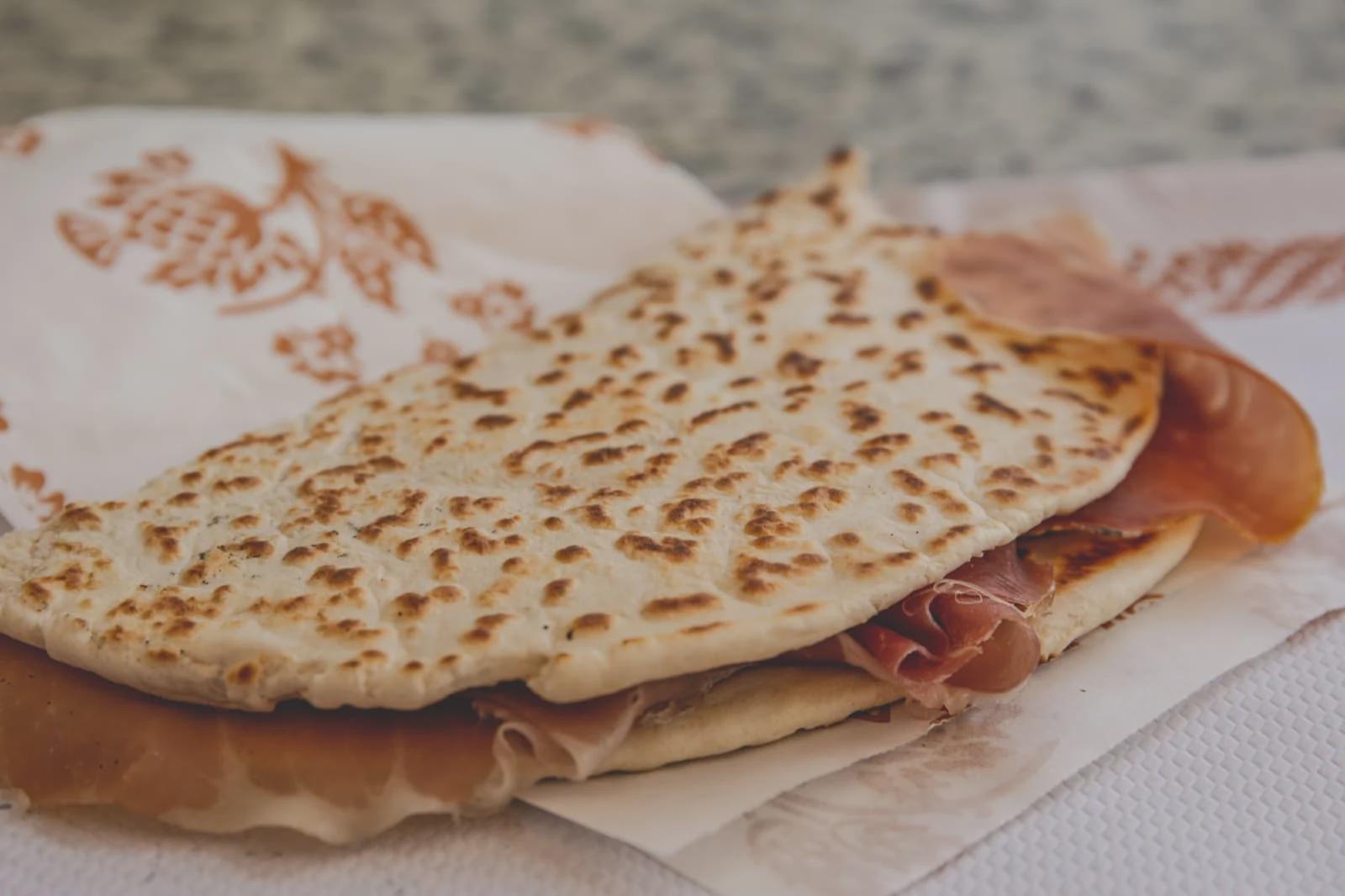
Piadina is a traditional flatbread from Romagna, in northeastern Italy, especially the provinces of Ravenna, Forlì-Cesena, Rimini, and parts of Pesaro-Urbino. Its history is very old and is tied to rural life, simple ingredients, and the food culture of central Italy.
The origins of piadina likely go back to ancient times. Similar unleavened or lightly leavened flatbreads were already made by Etruscans and Romans, using cereals ground into flour and cooked on hot stones or terracotta. In Roman times, writers described breads and focaccia-like preparations made from simple grain doughs, and piadina is often seen as part of that long flatbread tradition.
For centuries, piadina was the bread of the poor farming families of Romagna. Wheat flour, lard or olive oil, water, salt, and sometimes a little baking soda or yeast were inexpensive and easy to obtain. In homes where oven-baked bread was less practical, piadina could be prepared quickly on a hot plate or clay dish. It became a daily food, especially in the countryside, where it was eaten with cheese, herbs, onions, or cured meats.
One of the earliest famous literary references to piadina comes from Giovanni Pascoli, the Italian poet from Romagna, who in the early 20th century called it the “national bread of the Romagnoli.” This helped give piadina cultural prestige and connected it strongly to regional identity.
Traditionally, piadina was cooked on a testo, a flat stone or terracotta plate heated over the fire. Later this became a metal griddle. Recipes varied from area to area. In Rimini, piadina is usually thinner and wider. In the inland parts of Romagna, it is often thicker and smaller.
During the 20th century, piadina moved from being a humble rural food to becoming one of the best-known symbols of Romagna. After World War II, with tourism growing along the Adriatic coast, piadina stands and kiosks spread widely, serving it freshly filled with local ingredients such as squacquerone cheese, prosciutto, arugula, and grilled vegetables.
Today piadina is recognized across Italy and abroad as a classic Italian specialty. It remains closely linked to its homeland, and Piadina Romagnola / Piada Romagnola has received IGP status in the European Union, protecting its geographical identity and traditional production.
So, the history of piadina is really the story of a simple peasant flatbread that survived for centuries and became a lasting symbol of Romagna’s culture, hospitality, and cuisine.
by Alternative-Link-380
3 Comments
Sounds amazing, thanks for sharing
Buonissima
La piadeina! (Cit.)